

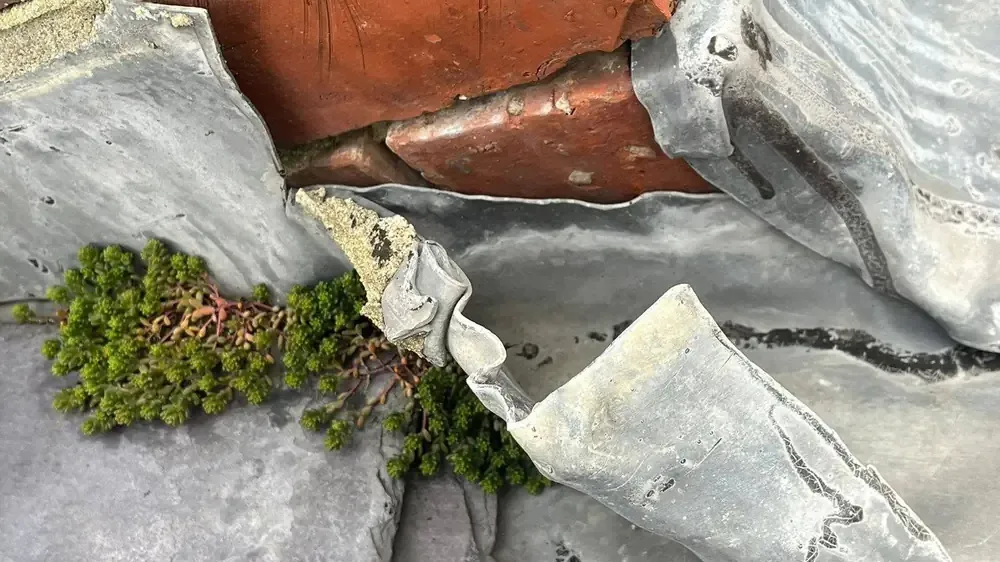
Lead flashing is the strip of lead that seals the joint wherever a roof meets something else: a chimney stack, a wall, a dormer or a roof light. It is one of the smallest parts of a roof and one of the most common reasons roofs leak.
When it fails, the leak often shows up some distance away, on a chimney breast, an upstairs ceiling or in the corner of a room. Knowing the signs means you can get it sorted before water has been reaching the timbers for a few winters.
What lead flashing actually does
Roof tiles and slates shed water well across the open roof. Where they meet a vertical surface, there is a gap that tiles alone cannot close. Lead is used because it can be shaped to fit the junction, it lasts a long time and it moves with the building as it heats and cools.
On a typical chimney you will find several pieces working together:
- Apron flashing across the front, where the stack meets the roof below it
- Step flashing up the sides, cut in steps to follow the brick courses
- Soakers under the tiles at the sides, which you cannot see from outside
- A back gutter behind the stack, to carry water around it
The upper edge of each flashing is tucked into a mortar joint in the brickwork and pointed in. That detail matters, and we come back to it below.
Signs your lead flashing has failed
Damp that comes and goes with the weather
The clearest sign is damp on a chimney breast, a ceiling or a wall next to the roof that gets worse after heavy or wind-driven rain and dries out between. Damp that stays the same whatever the weather is more likely to be something else, such as condensation.
Lead that has lifted or come loose
From the ground, look for lead standing proud of the brickwork or the tiles, or flapping in the wind. Over years, wind lifts the lower edge and thermal movement works the top edge loose from its joint.
Splits and cracks
Lead expands and contracts every day. If a piece is too long, fixed too tightly or too thin for where it is used, it can split along the folds. A crack in lead flashing is an open path for water.
Pointing missing from the top edge
Where the flashing tucks into the brickwork, the mortar holding it in place can crumble and fall out. You may see a dark line above the lead where there used to be mortar, or bits of mortar in the gutter.
Sealant where there should be pointing
If someone has run a bead of mastic or silicone along the top of the flashing instead of repointing it, that is usually a sign of an earlier quick fix. Sealant on lead and brickwork tends to crack and peel as both move, and it often means the leak has been patched rather than solved.
Lead that has been stolen or replaced with something else
Lead theft is less common on houses than on commercial buildings, but it happens. Some flashings are replaced with lead alternatives or flashing tape. These can be fine when fitted properly, but tape stuck to the face of brickwork is rarely a lasting repair.
What you can check yourself
You do not need to go on the roof. Most of this can be done from the ground with a pair of binoculars, or from a neighbour’s window that looks across your roof.
- Look along the joint between the chimney and the tiles on all sides you can see
- Check whether the lead sits flat, or has lifted or bent away
- Look for gaps, splits or dark lines along the top edge
- Check the gutter below for fragments of mortar or lead
- In the loft, look for staining on the timbers around the chimney on a dry day, and again after rain
If you see staining in the loft that lines up with the outside of the stack, the flashing is a likely cause.
Can lead flashing be repaired rather than replaced?
Often, yes. If the lead itself is sound and has just worked loose, it can be re-dressed back into position, refixed and repointed into the brickwork. That is a smaller job than replacement.
Replacement is the better option when the lead has split, has been cut too short to give enough cover, is too thin for the position it is in, or has been patched so many times that there is little sound lead left.
A useful guide for how thick lead should be: the lead industry grades sheet lead by “code”, with higher numbers being thicker. Code 3 is generally used for soakers hidden under the tiles, and Code 4 is the usual minimum for exposed flashings such as chimney aprons and step flashings. Very exposed details often use heavier lead. If thin lead has been used where it is exposed to the weather, it is more likely to split.
Why lead flashing fails early
Well-fitted lead flashing can last for decades. When it fails much sooner, it is usually down to how it was installed rather than the material itself. The common causes are:
- Pieces that are too long. Lead needs to be fitted in limited lengths so it can expand and contract without splitting.
- Not tucked into the brickwork. Flashing that is only stuck or screwed to the face of the wall relies on sealant to keep water out, and sealant does not last.
- Not enough cover. Flashing that does not overlap the tiles far enough lets wind-driven rain blow underneath.
- The wrong thickness. Thin lead on an exposed chimney is more likely to lift and split.
Is it the flashing, or something else?
Lead flashing is a common cause of chimney and abutment leaks, but not the only one. Cracked flaunching (the mortar cap that the chimney pots sit in), porous pointing on the stack, an open chimney pot letting rain down the flue, or a slipped tile next to the stack can all produce the same damp patch inside.
That is why a proper inspection looks at the whole junction rather than assuming the lead is to blame. Our guide on why a roof leaks explains how the timing and position of a leak point towards the cause, and what a roof inspection finds shows the kind of faults that are invisible from the pavement.
Getting your flashing checked
If you have damp near a chimney or a wall, or you can see lead that has lifted or split, it is worth having it looked at before winter. Small flashing repairs are much cheaper than replacing timbers that have been wet for years.
Forthcoming Group carries out chimney repairs and roof repairs across Sunderland and the North East, including lead flashing repairs and replacement. We inspect first, show you what we have found and give you a written quote.