

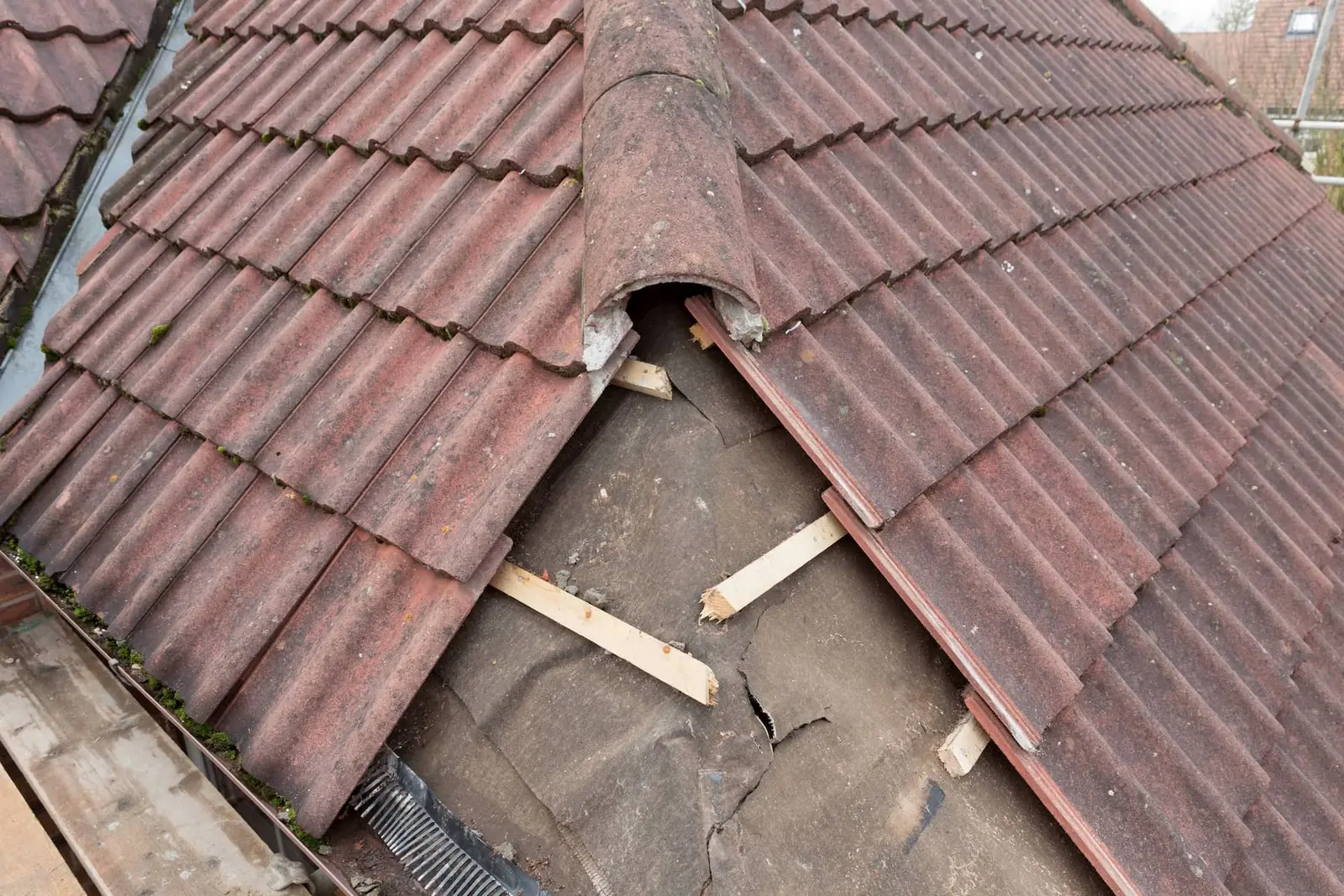
A damp patch appearing on a bedroom ceiling is unsettling, partly because it is hard to tell how serious it is. It might be one slipped tile. It might be an underlay that gave up two winters ago and has been quietly letting water through ever since.
This guide explains what actually causes roof leaks in UK homes, how to narrow down which one you are dealing with, what to do immediately, and when it genuinely needs a roofer rather than a wait-and-see.
If water is coming in now and you want someone to look at it, our roofing team covers Sunderland and the North East and roof inspections are free.
Key Takeaways
- Water almost never enters directly above where it appears inside. It travels along timbers first.
- Flashing around chimneys and abutments is one of the most common single sources of leaks in UK homes.
- When your roof leaks is one of the best clues to why it leaks.
- Not every ceiling stain is a leak. Condensation in the loft produces very similar signs and is fixed differently.
- Containing the water and protecting the ceiling matters more in the first hour than finding the cause.
- Going up on a wet roof to investigate is the most common way a minor roofing problem becomes a serious injury.
First, what to do right now
Before working out the cause, limit the damage:
- Put something underneath. A bucket or basin, with a towel in it to stop it drumming and splashing.
- Move furniture, electricals and anything soft out from under the affected area.
- If the ceiling is bulging, it is holding water. Pierce it with a screwdriver at the lowest point of the bulge, with a bucket beneath. Letting it drain in a controlled way is far better than letting a section of ceiling come down.
- Turn off electrics in the affected area at the consumer unit if water is anywhere near light fittings, downlights or cabling.
- Photograph everything, including the outside of the property if you can see damage from ground level. If you end up making an insurance claim, you will want this.
- Stay off the roof. Wet tiles are dangerous, and a roof that is already failing is not a surface to be walking on.
Water coming in now? We carry out free roof inspections across Sunderland and the North East. Arrange an inspection or call 0191 716 5095.
Why the leak is not where you think it is
This is the single most useful thing to understand about roof leaks.
Water entering at a fault rarely falls straight down. It runs along the underside of the underlay, down a batten, along a rafter, and drops at the first point where something interrupts its path, often a nail, a joint or a light fitting. That point can be several metres from where it got in.
It is why a stain above your landing might be caused by a problem near the chimney, and why “the leak is above this spot” is a guess rather than a diagnosis. It is also why chasing a leak with sealant from the outside so often fails. The sealant goes where the water appeared, not where it entered.
The most common causes
Slipped, cracked or missing tiles
The most frequent cause, and usually the most straightforward to put right. Wind lifts tiles, frost cracks them, and nail fixings corrode over decades until a tile slides. One missing tile exposes the underlay directly to weather, and if that underlay is already old, water gets through quickly.
How to spot it: visible gaps, tiles out of line or tile fragments in the gutter or on the ground after wind.
Failed flashing
Flashing is the metal, usually lead, that seals the junction between the roof and anything interrupting it: a chimney, an abutting wall, a dormer cheek, a roof window. These junctions are inherently the weakest points on any roof.
Lead flashing fails through building movement, thermal expansion over many years, failed pointing where it is tucked into the brickwork, or simply poor original installation. Chimneys are consistently among the most common sources of leaks in UK housing.
How to spot it: staining on a ceiling near a chimney breast, damp on the chimney breast itself, or lead that is visibly lifted, split or pulled out of the mortar joint.
Blocked gutters, outlets and valleys
If water cannot drain away, it backs up. A blocked gutter overflows backwards under the lowest course of tiles. A blocked valley, the channel where two roof slopes meet, is worse, because it concentrates water from two slopes into one place and then sends it into the roof structure.
How to spot it: water overflowing the front edge of the gutter during rain, plants growing in the gutter, staining running down the external wall below the gutter line.
Perished underlay
The underlay beneath the tiles is the roof’s second line of defence, and on older roofs it has often failed long before the tiles show any sign of age. Traditional bitumen felt becomes brittle, tears along the battens and sags between rafters.
This is the cause that most often turns a repair conversation into a replacement conversation, because once underlay has gone across the whole roof, patching it is not realistic.
How to spot it: from inside the loft, felt that is torn, sagging, crumbling at the edges or visibly deteriorated. If several small leaks appear in unrelated places, this is a likely explanation. Our guide on signs your roof needs replacing covers that situation in more detail.
Failed ridge and verge mortar
The mortar bedding ridge tiles along the top of the roof, and the tiles at the gable edge, has a finite life. Once it cracks and sections drop out, wind-driven rain gets underneath.
How to spot it: gaps or missing mortar visible along the ridge line from the ground, or lumps of mortar in the garden after high winds.
Flat roof splits and ponding
Flat roofs, typically over extensions, dormers, garages and porches, fail differently. Traditional felt splits as it ages and becomes brittle, particularly at upstands and joints. Water that sits rather than drains, known as ponding, accelerates it.
How to spot it: visible blisters, splits or tears, or standing water remaining more than a day or two after rain.
Condensation, which is not a leak at all
Worth knowing about, because it produces almost identical symptoms and is dealt with completely differently.
Warm, moist air from the house rises into a cold loft and condenses on the underside of the roof. The result is damp timbers, wet insulation and ceiling staining, with no fault in the roof covering whatsoever. It is often made worse by bathroom or kitchen extractors venting into the loft instead of outside, by loft hatches without seals, and by insulation blocking the eaves ventilation.
How to tell the difference: condensation tends to be widespread rather than localised, is worse in cold still weather rather than during rain, and often shows as droplets or a general dampness across the underside of the roof rather than a defined run or drip.
When it leaks tells you what it is
One of the most useful diagnostic questions is not where but when.
| When the leak appears | What it usually points to |
|---|---|
| Only during driving rain from one direction | Wind-driven rain past flashing, verge or a slipped tile on that elevation |
| Only during heavy, prolonged rain | Gutters, valleys or outlets backing up |
| Within minutes of rain starting | A direct opening, such as a missing tile |
| Hours after rain, or continuing after it stops | Water tracking a long path, often from underlay or a chimney |
| In cold, dry, still weather | Condensation rather than a leak |
| Only after snow | Melt water backing up under tiles, or blocked drainage |
Note the answer down before a roofer visits. It genuinely narrows things down and can save time on the roof.
What not to do
- Do not apply sealant or expanding foam from inside the loft. It traps water against timbers and makes the real fault harder to find.
- Do not have “roof coating” applied as a fix for a leak. A coating over a failing roof covers the symptom and can prevent the roof breathing properly.
- Do not get on the roof yourself, particularly in wet or windy conditions.
- Do not ignore a small, slow leak. The water damaging your timbers, insulation and plaster does not care how small the entry point is.
When to call a roofer
Call straight away if:
- Water is coming in actively during rain
- A ceiling is sagging, bulging or staining is spreading
- Water is near electrics
- Tiles are visibly missing or the ridge looks damaged after a storm
- Damp is appearing in more than one place
Book an inspection soon, but without panic, if:
- There is an old stain you have never got to the bottom of
- You have noticed moss build-up, mortar loss or tiles out of line
- Your roof is reaching an age where you would like to know where you stand
A proper inspection should identify the cause rather than just the symptom, tell you whether it is isolated or part of a wider problem, and set out what the options are. Our guide on how to choose the right roofing company in Sunderland covers what to expect and what to be wary of.
A note on insurance
Sudden, identifiable damage, most commonly storm damage, may be covered by your buildings insurance. Gradual deterioration through age and wear generally is not.
If a storm is responsible, report it promptly, photograph everything and get a professional assessment in writing. We can provide a written report of what we find to support a claim.
If the answer turns out to be a replacement rather than a repair, our case study of a roof replacement in Silksworth shows what that work involves.
Get your roof looked at
If your roof is leaking, the useful next step is having someone identify the actual cause rather than guessing at it from a ceiling stain.
Forthcoming Group carries out free roof inspections with no obligation. We will find where the water is getting in, explain what is causing it in plain terms, and set out your options in writing. If it is a simple repair, we will tell you that. Our roofing work covers repairs, replacements, flat roofs, storm damage, chimneys, fascias, soffits and guttering.
We work across Sunderland and the wider North East. See the areas we cover or read what our customers say.
Arrange your free roof inspection or call 0191 716 5095.
Frequently asked questions
Is a leaking roof an emergency?
It depends on the rate and location. A slow stain that has not changed in months is not an emergency, though it still needs looking at. Water running in during rain, a bulging ceiling or water anywhere near electrics should be dealt with urgently.
Why does my roof only leak sometimes?
Usually because the fault only lets water in under particular conditions. Wind-driven rain from one direction, prolonged rain that overwhelms drainage, or melting snow can each produce a leak that does not appear in ordinary rainfall. See the table above, which maps timing to likely cause.
Can I just put sealant over it?
It very rarely works, because the point where water appears is seldom the point where it entered. Sealant applied in the wrong place traps moisture and makes proper diagnosis harder later.
How much does a roof leak repair cost?
It depends entirely on the cause and the access needed. Published UK guides put simple repairs such as slipped tiles at roughly £150 to £500, with flashing work higher, and scaffolding adding several hundred pounds where ladder access is not safe. The honest answer is that the cause has to be identified before anyone can price it, which is why the inspection comes first.
How quickly can someone come out?
Contact us and we will arrange an inspection at a suitable time. If water is actively coming in, say so when you get in touch so it can be prioritised.