

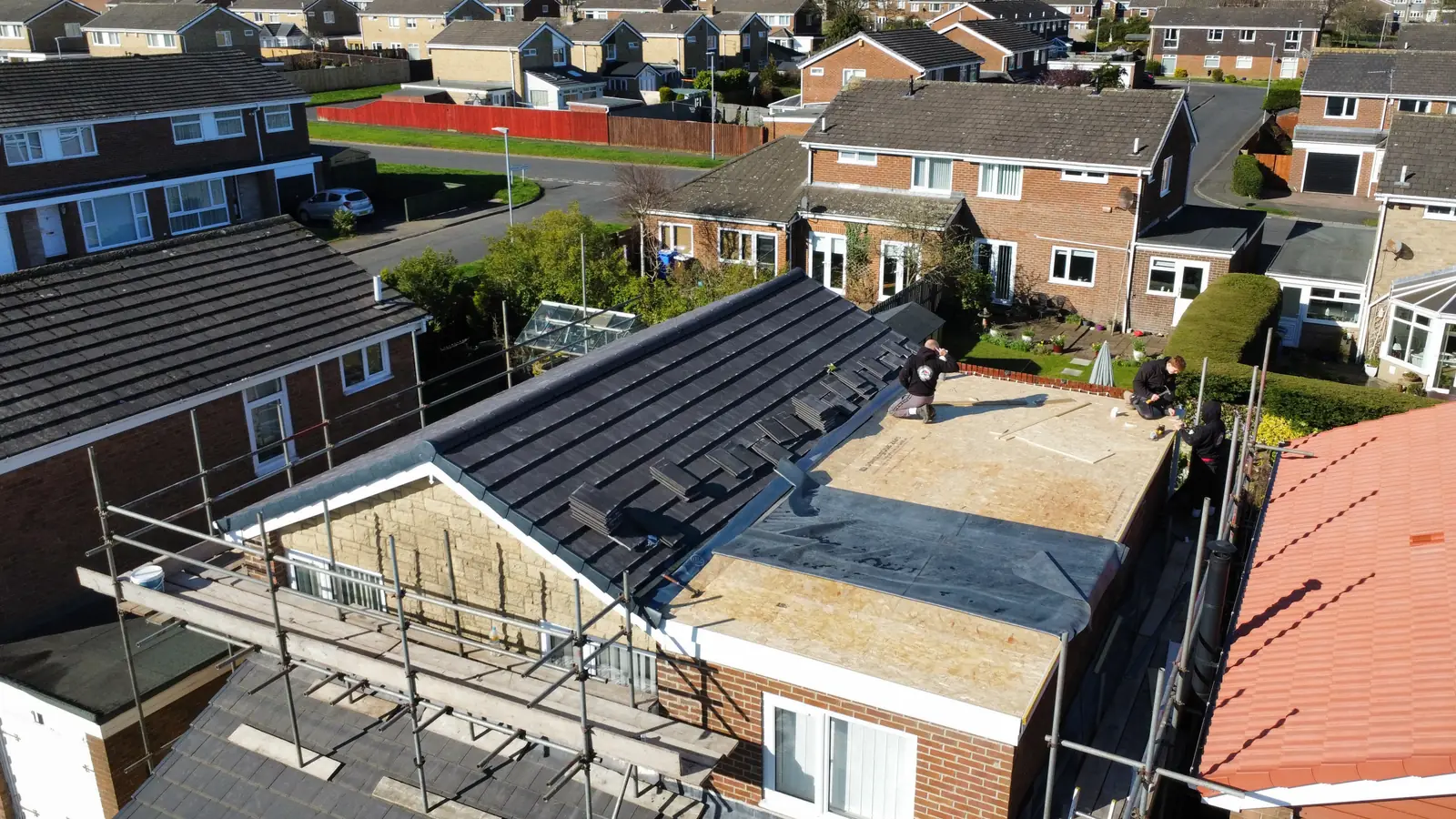
Roofs rarely fail all at once. They decline slowly, and most homeowners only start paying attention when something leaks. By then the question is no longer whether there is a problem but how far it has gone.
This guide sets out what to actually look for, from the pavement, from inside your loft and from inside the house. It also covers what is not a sign, because a fair amount of unnecessary roofing work gets sold on the back of moss and one slipped tile.
If you would rather have someone assess it properly, our roofing team provides free roof inspections across Sunderland and the North East.
Key Takeaways
- The difference between a repair and a replacement is usually isolated versus widespread.
- Age is the starting point. Concrete tiles typically last 40 to 60 years, clay 60 to 90, natural slate 80 and often far beyond.
- The underlay beneath the tiles commonly fails decades before the tiles themselves do.
- A ten-minute look in your loft tells you more than an hour of looking from the garden.
- Sagging or dipping in the roof line is the one sign that should always be looked at promptly.
- Moss, a single slipped tile or one leak are not evidence that a roof has failed.
Start with the roof’s age
Age does not decide the question, but it frames it. A fault on a fifteen-year-old roof is an event. The same fault on a fifty-year-old roof is usually a symptom.
| Covering | Typical service life |
|---|---|
| Concrete tiles | 40 – 60 years |
| Clay tiles | 60 – 90 years |
| Natural slate | 80 years and frequently beyond |
| Traditional felt (flat roofs) | 10 – 20 years |
| EPDM rubber (flat roofs) | around 30 years |
| Fibreglass / GRP (flat roofs) | 25 – 30 years |
There is an important catch. The covering is usually not the first thing to fail. Underlay, battens and mortar generally give out well before the tiles do, which is why a roof can look perfectly respectable from the street while the layer actually keeping water out has perished. If your house was built or last re-roofed before the mid-1980s, the underlay is the thing to be curious about, whatever the tiles look like.
If you do not know when the roof was last done, a survey report, your deeds or previous owners’ paperwork may tell you. Otherwise, a roofer can usually estimate it from the materials and fixing methods used.
Signs you can see from outside
You can do this from the ground with binoculars or a phone camera zoom. Do not get on the roof.
- Tiles slipped, cracked or missing in several places. One is a repair. A scattering across different elevations suggests the fixings or the battens are going.
- A sagging or dipping ridge line. Sight along the ridge. It should be straight. Dips or waves point to something structural beneath, and this is the one sign worth acting on quickly.
- Failed mortar on ridges and verges. Gaps along the ridge tiles or at the gable edge, or lumps of mortar in the garden after wind.
- Tiles that look worn rather than damaged. Concrete tiles lose their surface over decades and become porous and rough. Slate delaminates, flaking into layers.
- Heavy moss growth. Moss itself is not a disaster, but thick growth holds moisture against the tiles, lifts them slightly and blocks drainage.
- Debris in the gutters. Granules and fragments washing off tiles into the gutter indicate the covering is breaking down.
- Plant growth, or daylight visible through the roof from an upstairs window of a neighbouring property.
Signs you can see in the loft
This is the part most homeowners skip, and it is far more informative than anything visible from outside. Pick a bright day, take a torch, and be careful to step only on the joists.
- Daylight through the roof. Pinpricks of light where there should be none. On an unfelted roof some light at the eaves can be normal, but light through the body of the roof is not.
- The condition of the underlay. This is the main thing you are there for. Brittle, torn, sagging between rafters or crumbling at the edges all indicate it has reached the end. Compare a few different areas rather than judging on one spot.
- Damp staining on rafters and battens. Dark patches, tide marks or white salt deposits on the timbers.
- Wet or compressed insulation. Insulation that is damp, matted or discoloured has been getting wet.
- Mould or a musty smell. Persistent moisture rather than a one-off event.
- Timbers that are soft or spongy where you can safely reach them.
- Sagging between rafters, which can indicate the battens or decking are deteriorating.
Worth knowing: damp in a loft is not always a leaking roof. Condensation produces very similar signs and is fixed differently, usually by improving ventilation rather than re-roofing. It tends to be widespread and worse in cold, still weather rather than during rain. Our guide on why a roof leaks covers how to tell the two apart.
Signs inside the house
- Damp patches on upstairs ceilings, particularly ones that return after redecorating.
- Staining around a chimney breast, which usually points to flashing rather than the covering.
- Peeling paint or bubbling plaster on upstairs ceilings and the tops of walls.
- Leaks in more than one room. This is the significant one. A single leak is a fault. Leaks in unrelated places usually mean the roof as a whole is no longer doing its job.
What is not a sign your roof needs replacing
Worth saying plainly, because these get used to sell work that is not needed:
- Some moss. Worth clearing and keeping an eye on. Not a reason to re-roof.
- One slipped or cracked tile. A repair.
- A single leak with an obvious, isolated cause, such as a lifted piece of flashing.
- Discoloured or weathered tiles. Concrete tiles change colour with age. On its own, that is cosmetic.
- An older roof that is performing well. Age alone is not a fault. Plenty of fifty-year-old roofs are sound, and plenty of slate roofs are a great deal older than that.
- A cold-caller telling you they noticed something from the road. Get an independent opinion before agreeing to anything.
The pattern that actually matters
If you take one thing from this page: look for pattern, not incident.
| What you are seeing | What it usually means |
|---|---|
| One fault, one location, clear cause | Repair |
| Several faults, different locations, same roof | The roof is failing |
| Problems recurring in the same place after repair | The original diagnosis was wrong, or it is more extensive |
| Underlay failed across the roof | Replacement |
| Sagging or structural movement | Needs assessing promptly |
| Roof beyond service life with recurring faults | Replacement is usually better value |
What to do next
If you have recognised several of the signs above, the next step is an assessment by someone who can get up and look at the things you cannot see: the state of the underlay across the whole roof, the condition of the battens, whether the timbers have taken water, and whether the mortar is holding.
A worthwhile inspection should tell you what condition the roof is in, whether problems are isolated or systemic, roughly how much life is left in it, and what your options are with costs. You should be able to make the decision yourself afterwards, rather than being told what to do. Our guide on how to choose the right roofing company in Sunderland covers what a thorough inspection and written quote should include.
You can see what a full replacement actually involves in our case study of a roof replacement in Silksworth, from stripping back to the finished roof.
Have your roof assessed
If you are not sure where your roof stands, having it looked at properly is the quickest way to find out, and it does not commit you to anything.
Forthcoming Group carries out free roof inspections with no obligation across Sunderland and the North East. We will assess the covering and what sits beneath it, explain what we find in plain terms, and give you a clear written quote for whatever is needed. If the answer is that your roof has years left in it, that is what we will tell you. Insurance-backed guarantees are available on roof replacement projects.
See the areas we cover or read what our customers say.
Arrange your free roof inspection or call 0191 716 5095.
If you are at an earlier stage, our free guide, Avoid costly mistakes before starting your project, explains what to check before committing to any home improvement work. Download it here.
Frequently asked questions
How long does a roof last in the UK?
It depends on the material. Concrete tiles typically last 40 to 60 years, clay 60 to 90 and natural slate 80 years or considerably more. Flat roofs are much shorter, from 10 to 20 years for traditional felt up to around 30 for EPDM. Exposure matters too, and a roof facing prevailing weather will usually age faster than a sheltered one.
Can I tell if my roof needs replacing without going up on it?
You can get a long way. A look along the ridge line from the ground and a careful inspection of the loft will reveal most of the significant indicators. What you cannot assess from either position is the condition of the underlay and battens across the whole roof, which is normally the deciding factor.
Is it normal to see daylight in my loft?
A little light at the eaves can be normal on older, unfelted roofs. Daylight through the main body of the roof is not, and means there is a direct gap where water can also get in.
Should I replace my roof before selling the house?
Buyers’ surveys routinely flag roofing defects, and once flagged they tend to come off the offer at more than the work would have cost. A sound roof rarely commands a premium, but a questionable one can delay a sale or a mortgage valuation. Having it assessed before you market the property at least means you know what will be found.
Do you replace flat roofs as well as pitched?
Yes. Flat roofing systems are part of our roofing work, alongside repairs, replacements, storm damage, chimney repairs, fascias, soffits and guttering. The full list is on our roofing services page.
Which areas do you cover?
We work throughout Sunderland and the wider North East. The full list is on our areas we cover page, and if you are not sure whether we reach you, just ask.