

We carried out an inspection recently on a roof that looked perfectly respectable from the street. From the scaffold it was a different picture.
The photographs below are from that visit. Every one of them is a defect that was letting water in, or was about to, and not one of them was visible from the ground.
That is the honest case for having a roof looked at. Not that your roof is probably failing, but that the early stages of roof failure are invisible from exactly the place most people assess their roof from.
Key Takeaways
- From the pavement a failing roof and a sound one look much the same, because the defects are small and high up
- Slipped slates, lifted flashing and open mortar joints all let water in long before anything shows on a ceiling
- Vegetation between courses is a symptom of debris and moisture already sitting where neither should be
- An exposed fixing means the slate above it has moved, and a pattern of them means the nails are going
- Most of what an inspection finds is repairable until water has been reaching the timbers for a few winters
1. Slipped Slates
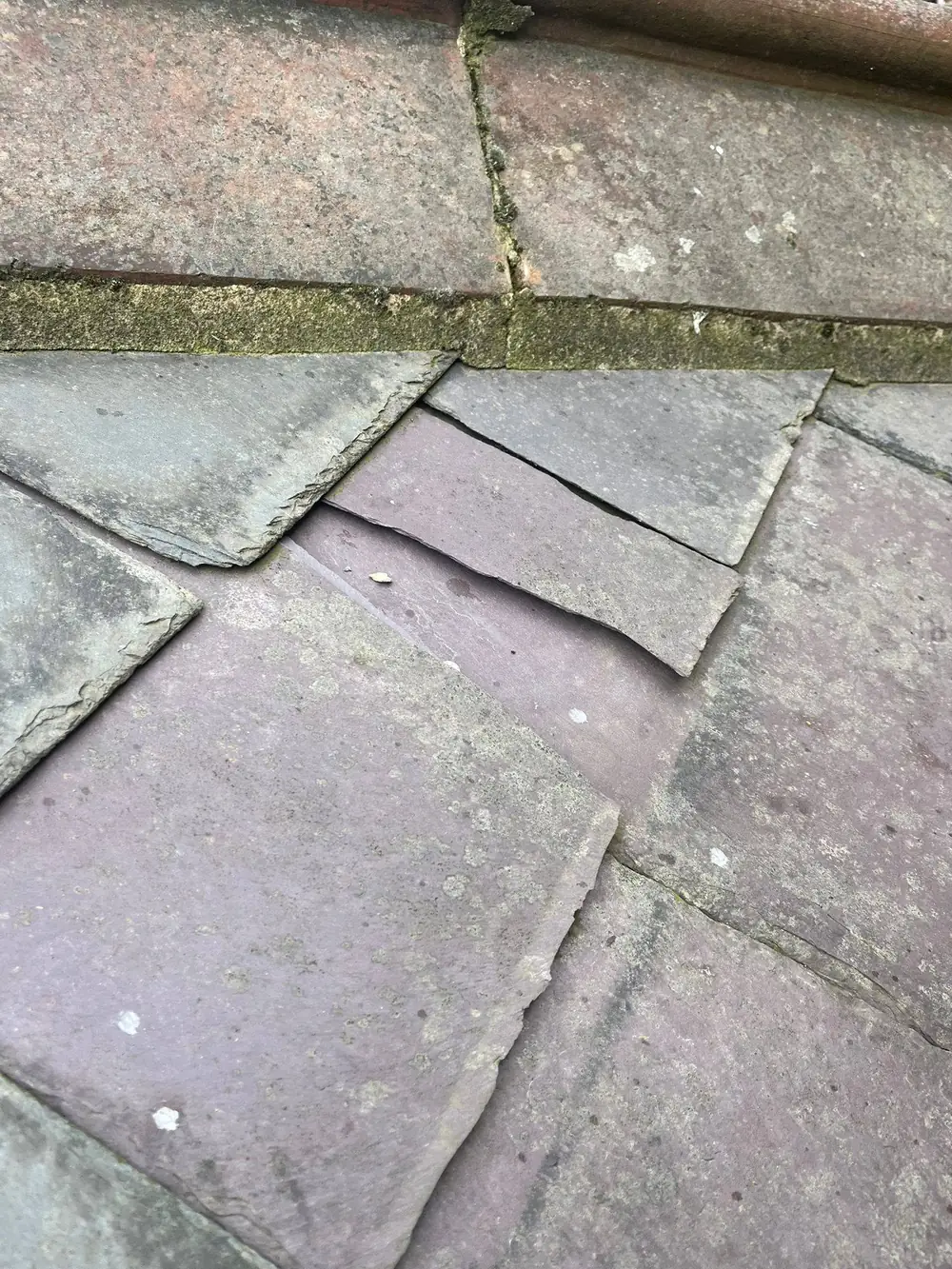
Slates do not usually fall off. They slide, a few millimetres at a time, as the nails holding them corrode and let go. The slate drops until it catches on the one below.
From the ground the roof still reads as a roof. Close up there are gaps in the coursing where the laps no longer overlap properly, and a lap that no longer overlaps is simply a channel pointing at your underlay.
This is the most common single finding on an older slate roof, and on its own it is a straightforward repair. Where slates are slipping in several places at once the fixings have usually gone rather than the slates, which makes it a slate roofing job rather than a patch.
2. Failed Flashing
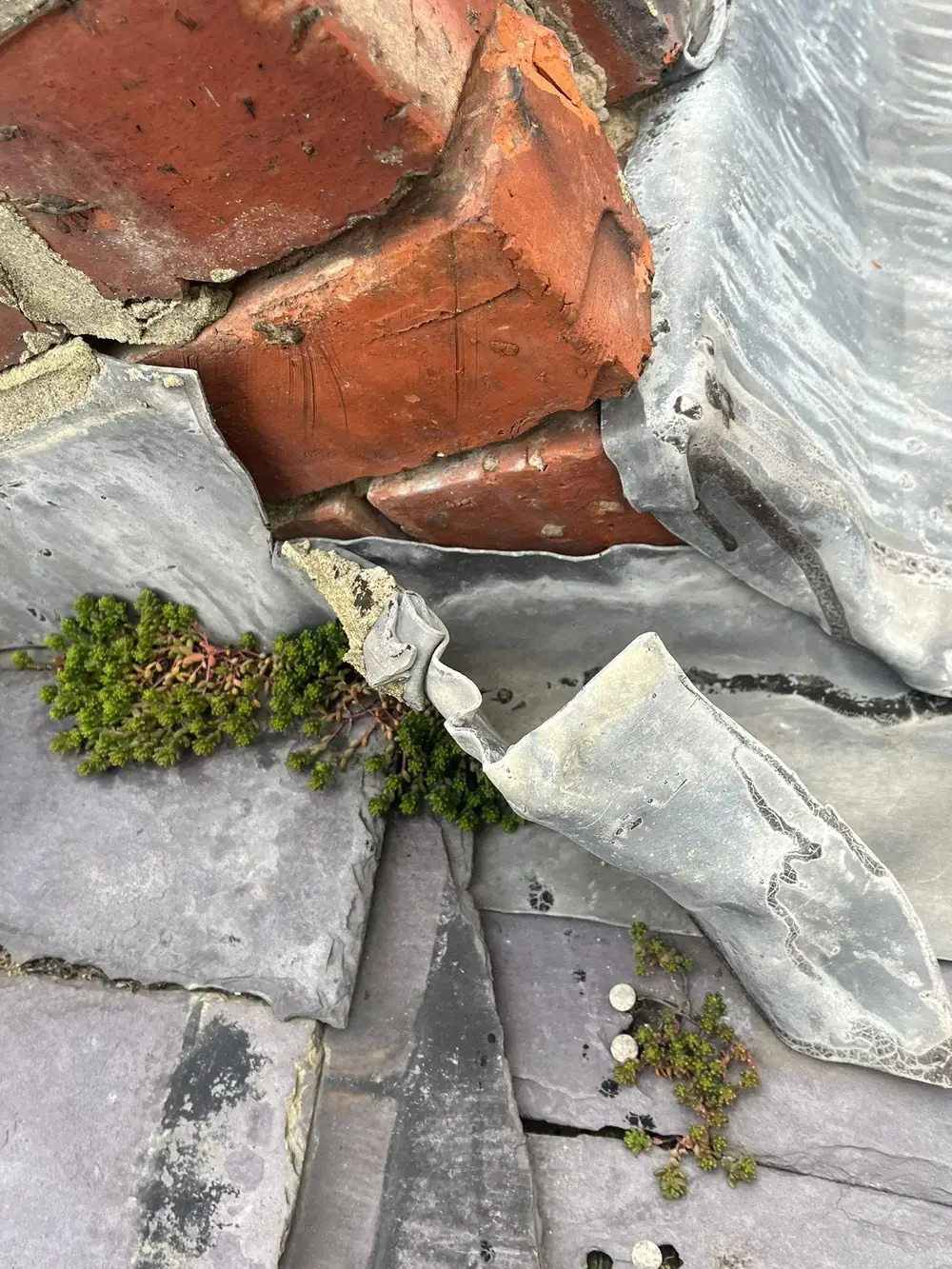
Flashing seals the junction between the roof and anything interrupting it: a chimney, an abutting wall, a dormer. Those junctions are the weakest points on any roof by design, because they are where two different things have to meet and stay watertight.
Lead lifts, curls and splits over decades through thermal movement and building settlement. Once the edge has lifted like this, wind-driven rain goes straight underneath it.
Flashing problems are the usual explanation when damp appears on a chimney breast rather than on an open stretch of ceiling.
3. Cracked Tiles
Frost does this. Water gets into a hairline crack or a porous patch, freezes, expands, and widens the crack a little more each winter.
A cracked tile is not dramatic. It leaks slowly and steadily into the same spot, which is precisely why it tends to be found as a damp patch that has been quietly spreading for a year or two rather than as a sudden leak.
4. Vegetation Between the Courses
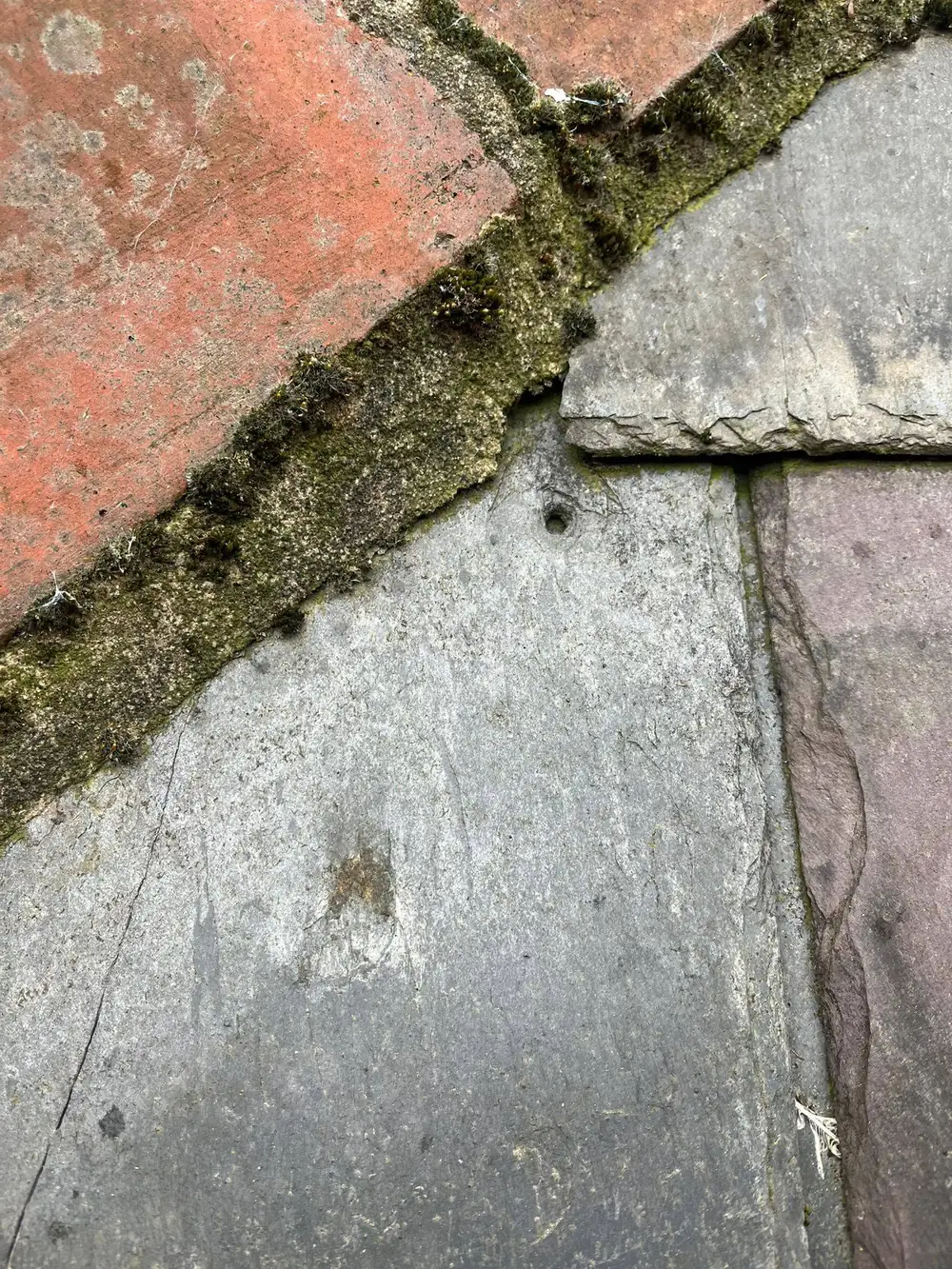
Plants growing out of a roof always surprise people. What they are actually telling you is that there is enough trapped debris and enough standing moisture up there to support a root system.
That is the real finding. The vegetation is the symptom. The problem is that water is sitting where it should be running off, and roots then widen whatever gap they started in.
5. Exposed Fixing Points
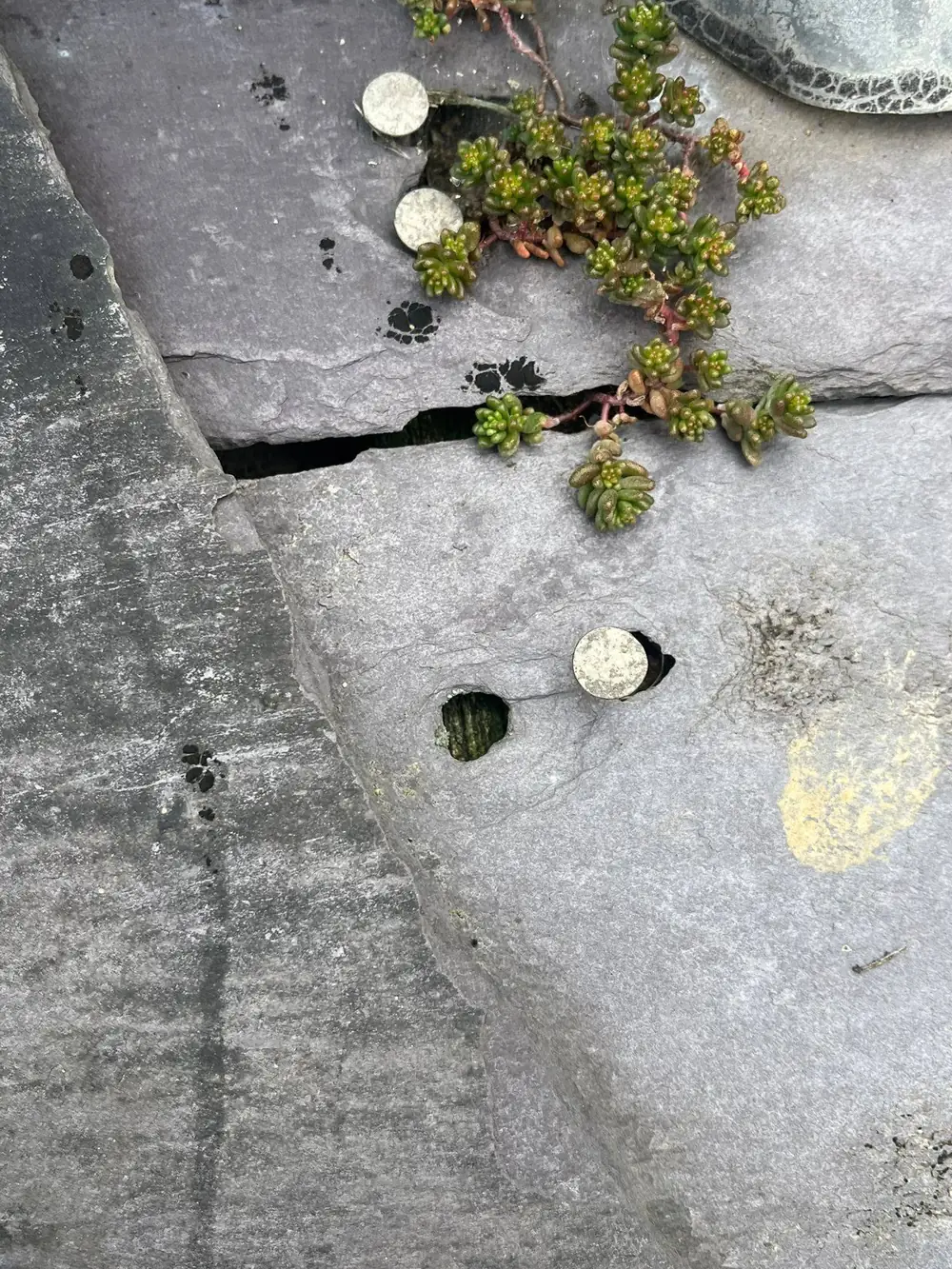
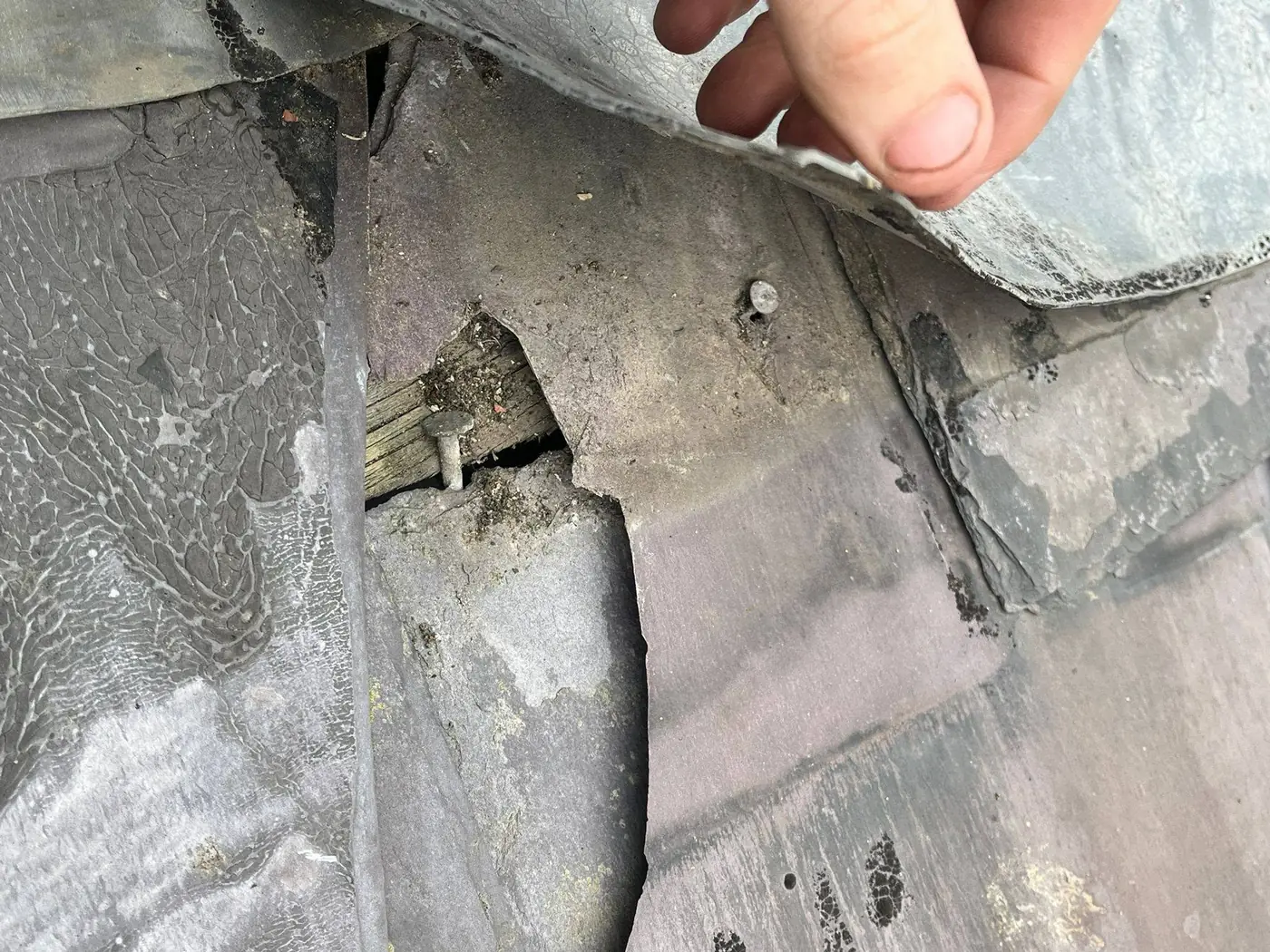
A nail head showing on the face of a slate means the slate that should be covering it has moved. The fixing is now exposed to weather, and there is an open hole alongside it going straight through to the batten.
One exposed fixing is a repair. Several across different parts of the roof usually means the nails are reaching the end of their life generally, which is a different and much bigger conversation.
6. Open Mortar Joints
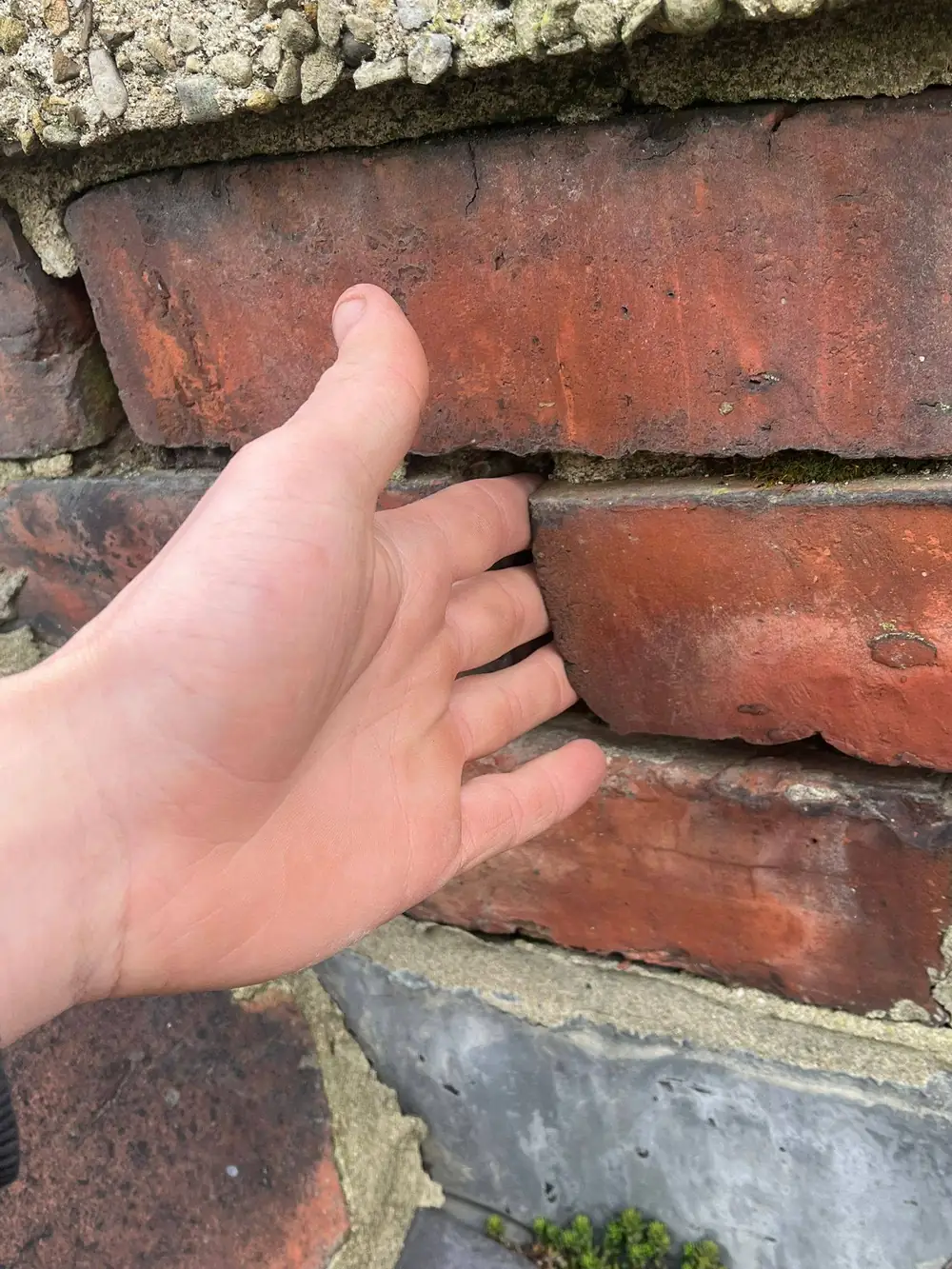
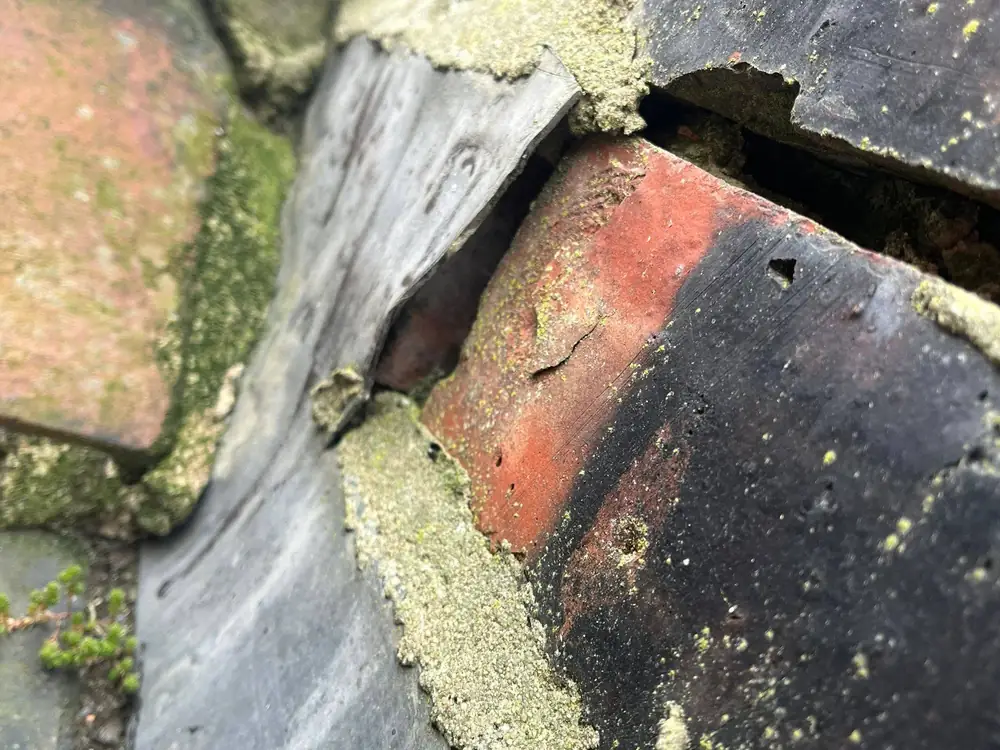
This joint is wide enough to put fingers into. Flashing is tucked into a joint like this and held there by the mortar, so when the mortar goes, the flashing has nothing holding it.
Pointing at roof level weathers faster than pointing further down the building, because it takes more wind and more rain and nobody ever looks at it.
Why None of This Shows From the Ground
Look at the photographs again and notice the scale. Most of these defects are a few centimetres across, sitting five or six metres up, on a surface you are viewing at an oblique angle from forty feet away.
From the pavement you can reasonably assess three things: whether the roof line is straight, whether there are obvious gaps, and whether there is heavy moss. Everything above is invisible at that distance, which is why roofs so often appear to fail suddenly. They do not. They fail gradually, out of sight, and then appear on a ceiling.
Our guide on the signs a roof needs replacing covers what you genuinely can assess yourself, including a loft checklist that tells you far more than looking at the outside does.
Most of these are a straightforward roof repair if they are caught early.
What Happens If These Are Left
Each defect here is minor on its own. What they share is that they all put water somewhere it should not be, and the damage runs in a predictable order.
Water gets past the covering. The underlay takes it, for a while. The battens stay damp and begin to soften. Then the rafters. Somewhere in that sequence a stain appears on a ceiling, which is usually the first thing the homeowner knows about it.
The cost follows the same order. Replacing a few slipped slates and repointing a flashing is a modest repair. Replacing battens and treating or renewing roof timbers is not, and the difference between the two is mostly how long it was left. Our guide on why a roof leaks explains how the water travels once it is in.
How Often Should a Roof Be Checked?
There is no legal requirement, and nobody needs an annual survey on a sound modern roof. As a sensible rule:
- After a storm, if there has been unusually high wind in your area
- Every few years once a roof is past about twenty years old
- Before you buy or sell, because roofing defects get flagged on surveys and come off the offer at more than the repair would have cost
- Whenever something changes, such as a new damp patch, debris in the gutters, tiles on the ground, or a leak that comes and goes
A proper inspection should leave you with photographs of what was found, an explanation of what each item means, and a clear view of what is urgent against what can wait. If someone tells you a roof needs replacing without showing you why, ask them to. Our guide on how to choose the right roofing company in Sunderland covers what a thorough inspection should involve.
Frequently Asked Questions
Do I Need a Roof Inspection If There Is No Leak?
Not necessarily, but the point of an inspection is to find things before they become leaks. Most of the defects above had not yet produced any visible sign inside the property. Once a leak appears, water has usually been getting in for some time.
How Long Does a Roof Inspection Take?
Typically under an hour for a domestic roof, depending on size, access and how much there is to look at. You do not need to be there for all of it, though it is worth being around at the end so the findings can be explained to you.
Will You Try to Sell Me a New Roof?
No. Most of what an inspection turns up is repairable, and we will say so when it is. A roof needs replacing when faults are widespread rather than isolated, or when the underlay and battens have gone, and we will show you the evidence either way.
Can I Inspect the Roof Myself?
You can do a useful amount from the ground with binoculars, and more from inside the loft. What you cannot safely or usefully do is get onto the roof, which is where everything on this page was photographed from. Climbing onto a roof that may already be compromised is how a roofing problem becomes an injury.
Have Your Roof Inspected
Forthcoming Group carries out free roof inspections across Sunderland and the North East with no obligation. We will photograph what we find, explain it in plain terms, and set out what needs doing now against what can reasonably wait.
If the answer is that your roof is fine, that is what we will tell you.
You can see roofing projects we have completed, check the areas we cover or read what our customers say.
Arrange your free roof inspection or call 0191 716 5095.